Open-source food, water and energy security.
A Seed is a small, self-running food system: fish and plants in one loop, in a unit about the size of a shipping container, that grows a varied diet with little from outside and is honest about what it costs to run.
Every plan, parts list, line of code and dataset gets published, so anyone can build one. Part of anything earned from Seeds goes to getting them, cheap or free, to the people who need one most. I'm looking for partners to build the first one.
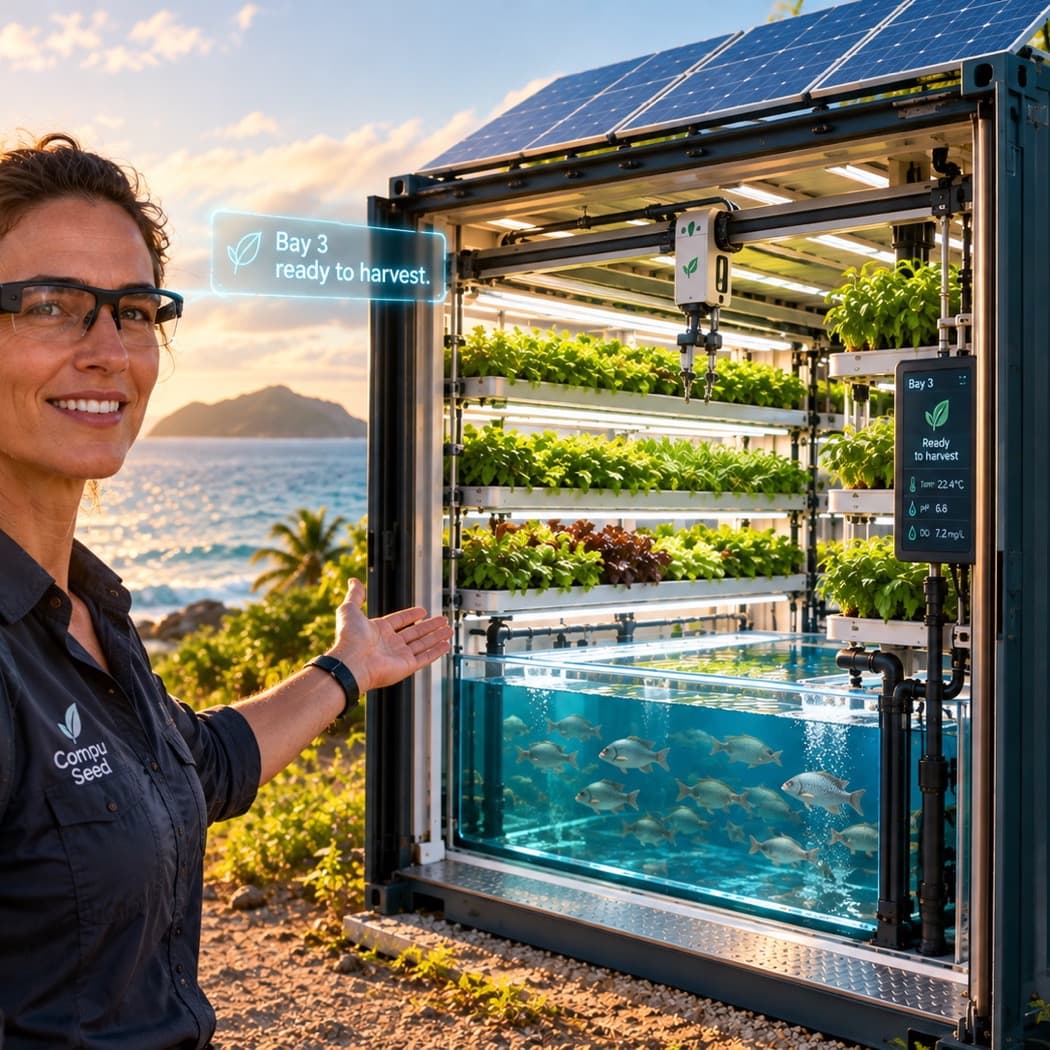
Fish feed the plants. The plants clean the water.
An aquaponic system raises fish and plants in one loop. Fish waste feeds the plants, and the plants clean the water for the fish. It's the same kind of partnership as the bees and the flowers: neither side is in charge, and both come out ahead.
The baseline Seed is a 10–20 ft shipping container. Smaller classroom-scale versions come out of the same work. Sensors, a robot gantry and local computing can do much of the tending, but every one of them gets metered, because a system that only works on cheap power and hidden labor isn't one anyone else can run.
I started building the first version of this in 2017 with students across programs at a vocational high school. When COVID hit, that project fell apart. In 2020 I started over on my own with a 10-gallon tank and built up from there: open sensors, automatic control, a small computer cluster. Now the technology is ready for a bigger build, and for students to learn alongside it.
Three open questions.
Can one unit grow a varied diet?
Which fish and plants can share one loop, given their different needs for temperature, pH and nutrients? It may not be possible in one container. Finding that out is a result too.
What does it really cost to run?
Water, feed, electricity and carbon per kilogram of food, measured, not estimated. That includes the energy used by the automation and computing, not just the pumps and lights.
Is the automation worth it?
Sensors, robotics and local computing can cut daily labor, but they use energy and materials. When do they pay for themselves, and when don’t they?
Results count either way. “It can't be done in one container” is a finding worth publishing, as long as it's measured honestly. Raw data and failures get published alongside the successes.
Start small, open up in layers.
Each layer starts when the one before it has given it something real to work on. The first needs only a handful of people.
- 1
Bench loop
A small working loop, about the size of a large desk: tank, grow bed, pump, open sensors, and an energy meter on every load, logging to an open dashboard.
- 2
First experiment
One controlled experiment on the bench loop, run and reported. The container design drawn and costed.
- 3
The container
A 10–20 ft container built from the open design and running, with its footprint measured from day one.
- 4
Automation, measured
A FarmBot-style robot gantry and hands-free guidance at the system, each judged by what it saves against what it costs to run.
Go build it yourself. Here’s everything you need.
The model is FarmBot, the open-source farming robot: free plans, open code, and more than a thousand schools using it. We found no maintained open design for a whole container-scale aquaponic system. That's the gap.
Anyone can use it, for anything.
Anyone can build, change or sell it, but improvements stay open, so no one can close the design and sell it back to the people it’s meant for.
Anyone can reuse it, with credit.
The first working Seed is a reference unit too: it shows how one runs, gives people something to learn from, and lets anyone check the published numbers against a real one.
As many Seeds as people need.
Open plans are free, but not everyone has the time, tools or money to build from plans. So the plan is to make Seeds a business too: kits, or units built for people who'd rather buy one.
Part of the profit goes to getting Seeds to people who couldn't otherwise afford one and could use one. That isn't a footnote. Working out who benefits most, and how sales and grants can pay for the units that go out free, is part of the project from the start.
The equipment, and the time.
- The equipment a first build needs, provided by Gold’s Honey. Already on hand: a FarmBot, and the sensors and controller from earlier builds.
- A small local computer cluster, and wall-plug energy meters for honest measurement.
- An open-source controller with a simulator and tests, so software work can start before any hardware exists.
- 15+ years teaching math, statistics and computer science, a school makerspace and robotics program, and a cross-program student build in 2017.
- About $50K in grants won and delivered, and weekly hands-on mentoring.
- The computing side of a Seed, the controller, its memory and the local reasoning, is HKOS. How HKOS fits a Seed →
It won't get built by one person in a garage.
If you could help make a Seed real, by bringing students, a site, build skills or funding, write. A short note is plenty. The scope is still open, and partners who join early help decide it.
Start a conversationColleges & programs
Environmental science, biology, engineering, computer science, data science, business. Students get real, public work with their names on it, and credit through a capstone, independent study, co-op or club.
A place to put it
A greenhouse, a farm, or a school with room to spare. The bench loop needs water, a drain and ordinary power. The container needs an outdoor pad with power and water.
Builders & makers
People who can help turn an open design into kits that can be built well and sold at a fair price, so the sales can pay for Seeds that go out free.
Funders
Grant programs and people who want open food, water and energy systems to exist, and want the numbers published honestly, whatever they turn out to be.